 Physics
📄 Print pdf
00971504825082
Doppler Effect
What is the Doppler Effect?
The effect was discovered by the Austrian physicist Christian Doppler in 1842.
The Doppler effect is an apparent change in frequency or wavelength when the wave source moves relative to the observer (or the observer moves relative to the source). This effect is observed in sound waves and electromagnetic waves like light. A classic example: the change in pitch of a siren as an ambulance passes by you.
When the source of a sound wave moves relative to the observer hearing the wave,
there is a shift in the apparent frequency heard by the observer.
See the animation below to understand the process.
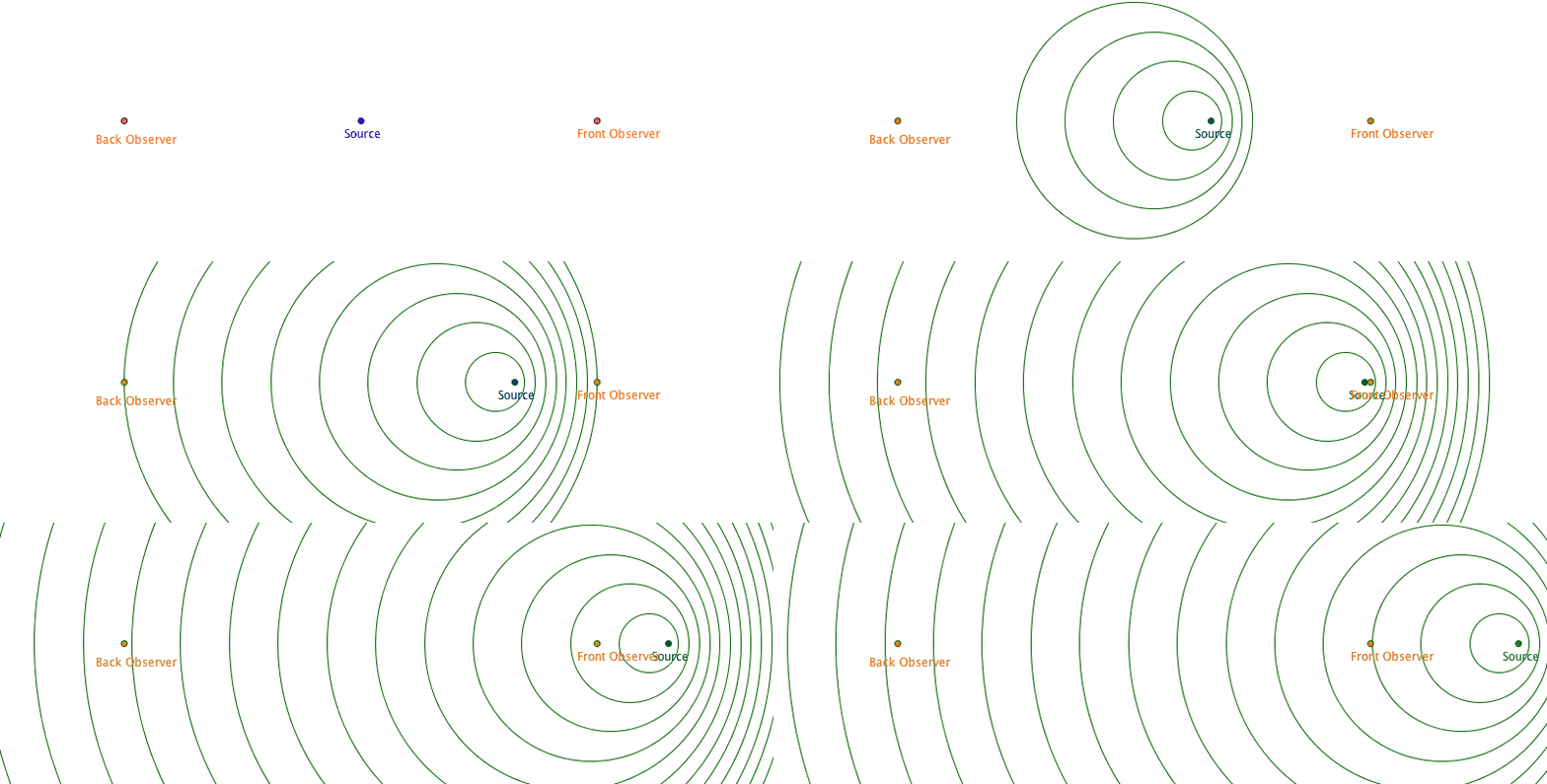
Doppler Effect (sound source moving slower than sound speed)
Notice how the sound waves bunch up in front of the source and stretch out behind it.
More wave peaks reach the front observer's ear each second.
Compared to the actual frequency produced by the source, the observer in front perceives
a higher frequency while the observer behind perceives a lower frequency.
A similar shift occurs if the source is stationary and the observer moves toward or away from it.
When moving toward the sound source, a higher frequency is perceived. When moving away, a lower frequency is perceived.
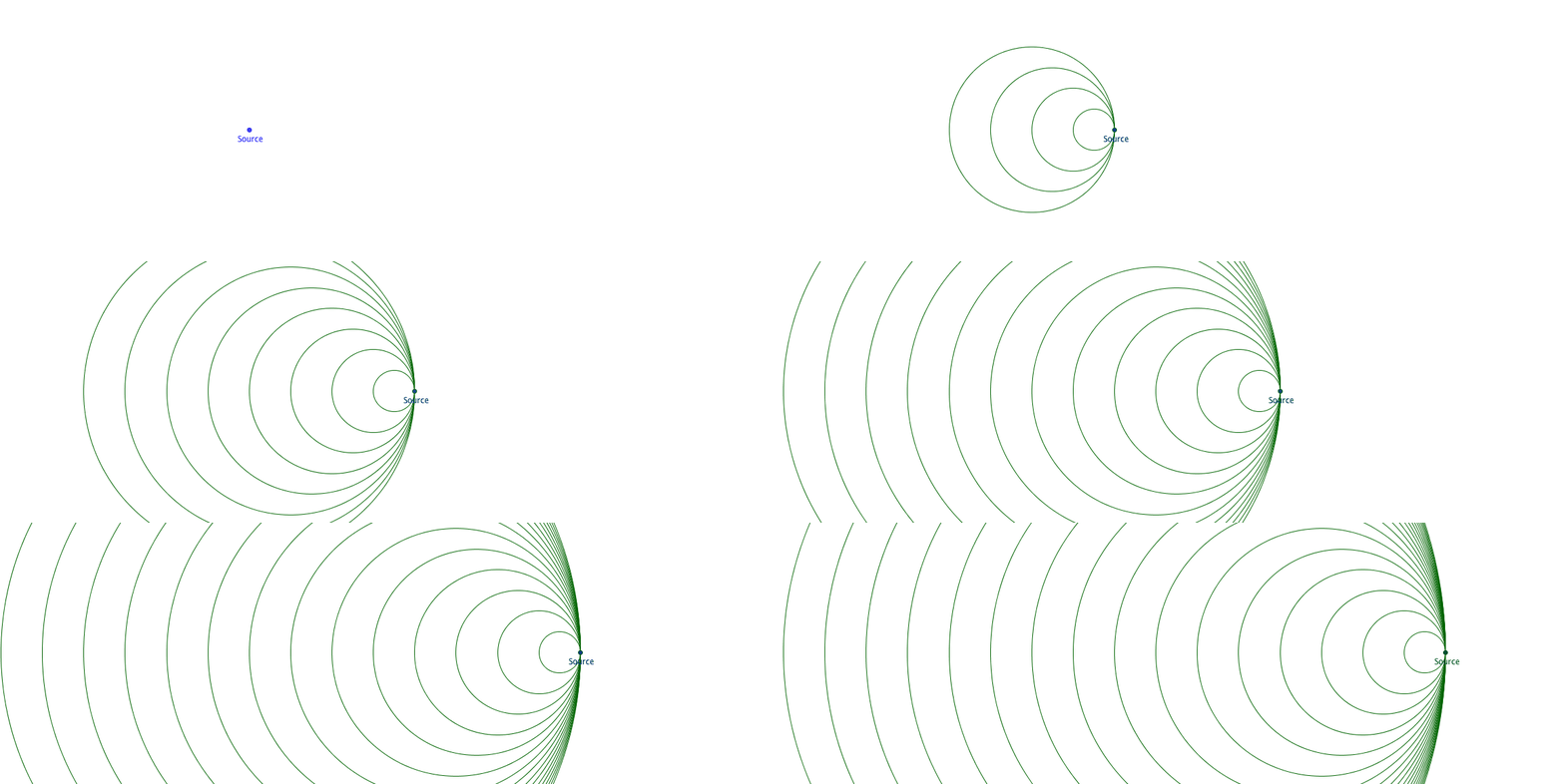
Sound source moving at the speed of sound
When a sound source approaches the speed of sound, the wavelengths in front approach zero.
As waves compress together in front of the source, a large area of constructive interference builds up.
If this large constructive interference area reaches an observer's ear, a sonic boom is heard.

Sound source moving faster than the speed of sound
The moment this cone's edge crosses an observer's path, a loud sonic boom-type sound is heard.
Note that the sonic boom isn't something that happens at the instant the source breaks the sound barrier,
but rather results from the continuous shock wave trailing behind the sound source. See the animation above and notice the boom occurring exactly when the wave edge crosses each observer's position.
Doppler Effect and Its Applications
Basic Equations:
Observer moving away from source
Observer moving toward source
Stationary observer
\[f_d=f_s\frac {v-v_d}{v-v_s}\]
\[f_d=f_s\frac {v-v_d}{v}\]
\[f_d=f_s\frac {v+v_d}{v}\]
\[f_s=f_d\]
Stationary source
\[f_d=f_s\frac {v-v_d}{v-v_s}\]
\[f_d=f_s\frac {v+v_d}{v-v_s}\]
\[f_d=f_s\frac {v}{v-v_s}\]
Source moving toward observer
\[f_d=f_s\frac {v-v_d}{v+v_s}\]
\[f_d=f_s\frac {v+v_d}{v+v_s}\]
\[f_d=f_s\frac {v}{v+v_s}\]
Source moving away from observer
Practical Applications:
Speed Radars 🚔
Used to measure vehicle speeds by calculating changes in reflected wave frequencies.
Weather Monitoring 🌪️
Determining wind speeds and storm movements using Doppler radar.
Medical Examinations 🏥
Measuring blood flow velocity in blood vessels (color Doppler).
Astronomy 🌌
Studying star and galaxy movements through redshift/blueshift.
Warning Systems 🚨
Speed detectors in modern cars when emergency vehicles approach.
Doppler Effect Sound Simulation
Doppler Effect Sound Simulation
Use the simulation below to experience the Doppler Effect and hear the sound.
Doppler Effect |
What is the Doppler Effect?
The effect was discovered by the Austrian physicist Christian Doppler in 1842.
The Doppler effect is an apparent change in frequency or wavelength when the wave source moves relative to the observer (or the observer moves relative to the source). This effect is observed in sound waves and electromagnetic waves like light. A classic example: the change in pitch of a siren as an ambulance passes by you.
When the source of a sound wave moves relative to the observer hearing the wave,
there is a shift in the apparent frequency heard by the observer.
See the animation below to understand the process.
Doppler Effect (sound source moving slower than sound speed)
Notice how the sound waves bunch up in front of the source and stretch out behind it.
More wave peaks reach the front observer's ear each second.
Compared to the actual frequency produced by the source, the observer in front perceives
a higher frequency while the observer behind perceives a lower frequency.
A similar shift occurs if the source is stationary and the observer moves toward or away from it.
When moving toward the sound source, a higher frequency is perceived. When moving away, a lower frequency is perceived.
Sound source moving at the speed of sound
When a sound source approaches the speed of sound, the wavelengths in front approach zero.
As waves compress together in front of the source, a large area of constructive interference builds up.
If this large constructive interference area reaches an observer's ear, a sonic boom is heard.
Sound source moving faster than the speed of sound
The moment this cone's edge crosses an observer's path, a loud sonic boom-type sound is heard.
Note that the sonic boom isn't something that happens at the instant the source breaks the sound barrier,
but rather results from the continuous shock wave trailing behind the sound source. See the animation above and notice the boom occurring exactly when the wave edge crosses each observer's position.
Doppler Effect and Its Applications
Basic Equations:
Observer moving away from source
Observer moving toward source
Stationary observer
\[f_d=f_s\frac {v-v_d}{v-v_s}\]
\[f_d=f_s\frac {v-v_d}{v}\]
\[f_d=f_s\frac {v+v_d}{v}\]
\[f_s=f_d\]
Stationary source
\[f_d=f_s\frac {v-v_d}{v-v_s}\]
\[f_d=f_s\frac {v+v_d}{v-v_s}\]
\[f_d=f_s\frac {v}{v-v_s}\]
Source moving toward observer
\[f_d=f_s\frac {v-v_d}{v+v_s}\]
\[f_d=f_s\frac {v+v_d}{v+v_s}\]
\[f_d=f_s\frac {v}{v+v_s}\]
Source moving away from observer
Practical Applications:
Speed Radars 🚔
Used to measure vehicle speeds by calculating changes in reflected wave frequencies.
Weather Monitoring 🌪️
Determining wind speeds and storm movements using Doppler radar.
Medical Examinations 🏥
Measuring blood flow velocity in blood vessels (color Doppler).
Astronomy 🌌
Studying star and galaxy movements through redshift/blueshift.
Warning Systems 🚨
Speed detectors in modern cars when emergency vehicles approach.
Doppler Effect Sound Simulation
Doppler Effect Sound Simulation
Use the simulation below to experience the Doppler Effect and hear the sound.
What is the Doppler Effect?
The effect was discovered by the Austrian physicist Christian Doppler in 1842.
The Doppler effect is an apparent change in frequency or wavelength when the wave source moves relative to the observer (or the observer moves relative to the source). This effect is observed in sound waves and electromagnetic waves like light. A classic example: the change in pitch of a siren as an ambulance passes by you.When the source of a sound wave moves relative to the observer hearing the wave,
there is a shift in the apparent frequency heard by the observer.
See the animation below to understand the process.
Doppler Effect (sound source moving slower than sound speed)
Notice how the sound waves bunch up in front of the source and stretch out behind it.
More wave peaks reach the front observer's ear each second.
Compared to the actual frequency produced by the source, the observer in front perceives
a higher frequency while the observer behind perceives a lower frequency.
A similar shift occurs if the source is stationary and the observer moves toward or away from it.
When moving toward the sound source, a higher frequency is perceived. When moving away, a lower frequency is perceived.
Sound source moving at the speed of sound
When a sound source approaches the speed of sound, the wavelengths in front approach zero.
As waves compress together in front of the source, a large area of constructive interference builds up.
If this large constructive interference area reaches an observer's ear, a sonic boom is heard.
Sound source moving faster than the speed of sound
The moment this cone's edge crosses an observer's path, a loud sonic boom-type sound is heard.
Note that the sonic boom isn't something that happens at the instant the source breaks the sound barrier,
but rather results from the continuous shock wave trailing behind the sound source. See the animation above and notice the boom occurring exactly when the wave edge crosses each observer's position.
Basic Equations:
Observer moving away from source |
Observer moving toward source |
Stationary observer |
\[f_d=f_s\frac {v-v_d}{v-v_s}\] |
\[f_d=f_s\frac {v-v_d}{v}\] |
\[f_d=f_s\frac {v+v_d}{v}\] |
\[f_s=f_d\] |
Stationary source |
\[f_d=f_s\frac {v-v_d}{v-v_s}\] |
\[f_d=f_s\frac {v+v_d}{v-v_s}\] |
\[f_d=f_s\frac {v}{v-v_s}\] |
Source moving toward observer |
\[f_d=f_s\frac {v-v_d}{v+v_s}\] |
\[f_d=f_s\frac {v+v_d}{v+v_s}\] |
\[f_d=f_s\frac {v}{v+v_s}\] |
Source moving away from observer |
Practical Applications:
Speed Radars 🚔
Used to measure vehicle speeds by calculating changes in reflected wave frequencies.
Weather Monitoring 🌪️
Determining wind speeds and storm movements using Doppler radar.
Medical Examinations 🏥
Measuring blood flow velocity in blood vessels (color Doppler).
Astronomy 🌌
Studying star and galaxy movements through redshift/blueshift.
Warning Systems 🚨
Speed detectors in modern cars when emergency vehicles approach.
No comments:
Post a Comment