 Physics
Question Bank: Electric Field Applications |

📄 Print PDF
00971504825082
\[1\star\]
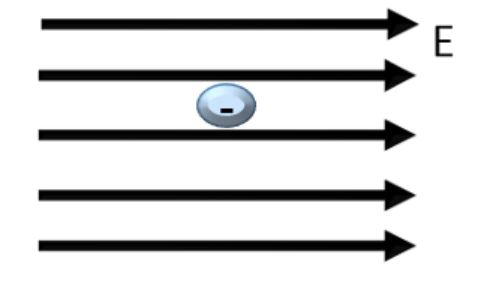
An electric field with intensity
\[3×10^2\;\;N/C\]
An electron is placed inside the field.
The electric force acting on the electron equals
\[q_e=1.6 ×10^{-19}C\]
\[ Fe= 5.2×10^{-12}\;\; N\;\;\;\;\;\;-C\]
In the direction of the field
\[ Fe= 4.8×10^{-17} \;\; N \;\;\;\;\;\;-A\]
In the direction of the field
\[ Fe= 5.2×10^{-12}\;\; N\;\;\;\;\;\;-D\]
Opposite to the field direction
\[ Fe= 4.8×10^{-17} \;\; N\;\;\;\;\;\;-B\]
Opposite to the field direction
 Click here to show solution
Choose the correct answer
\[2\star\]
An electric charge of magnitude \[q=+6\;\;µc\]
The electric field at the point
at a distance from the charge equals \[a=0.2 \;\;m\]

\[ E = 6.75×10^{6}\;\; N/C\;\;\;\;\;\;-C\]
To the right
\[ E = 1.35×10^{6} \;\; N/C \;\;\;\;\;\;-A\]
To the right
\[ E = 3.25×10^{6}\;\; N/C\;\;\;\;\;\;-D\]
To the left
\[ E = 4.52×10^{6} \;\; N/C\;\;\;\;\;\;-B\]
To the left
Click here to show solution
Choose the correct answer
\[3\star\]
An electric field with intensity \[ E=300 \;\;N/C\]
A particle is placed inside the field and is affected by an electric force of magnitude
\[9×10^{-12}\;\;N\]
in the direction of the field. The type and magnitude of the particle's charge equal

\[ q= 6×10^{-14}\;\;C\;\;\;\;\;\;-C\]
Negative
\[ q= 9×10^{-14} \;\; C \;\;\;\;\;\;-A\]
Negative
\[ q= 4×10^{-14}\;\; C\;\;\;\;\;\;-D\]
Positive
\[ q= 3×10^{-14} \;\; C\;\;\;\;\;\;-B\]
Positive
Click here to show solution
Choose the correct answer
\[4\star\star\]
An electric charge of magnitude
\[Q=4\;\; µc\]
The electric field at point \[A\]
was calculated to be
\[3×10^4\;\;N/C\] The distance of the point from the charge equals

\[r=1.1 \;\;m\;\;\;\;\;\;-C\]
\[ r=1.4 \;\;m \;\;\;\;\;\;-A\]
\[ r=0.85 \;\;m\;\;\;\;\;\;-D\]
\[ r= 0.56 \;\;m\;\;\;\;\;\;-B\]
Click here to show the solution
Choose the correct answer
\[5\star\]
One of the following measurement units is equivalent to the unit of electric field measurement
\[Kg.m.A^{-1}S{-1}\;\;\;\;\;\;-C\]
\[ Kg.m.A^{-2}S{-2} \;\;\;\;\;\;-A\]
\[ Kg.m.A^{-1}S{-2}\;\;\;\;\;\;-D\]
\[ Kg.m.A^{-1}S{-3}\;\;\;\;\;\;-B\]
Click here to show solution method
Choose the correct answer
\[6 \star\]
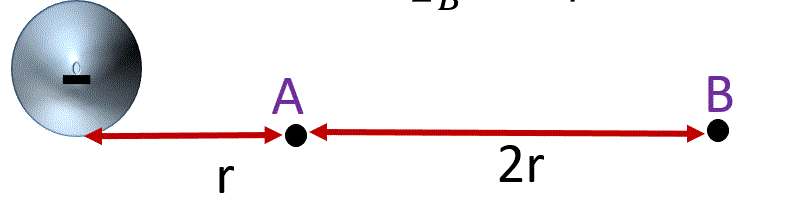
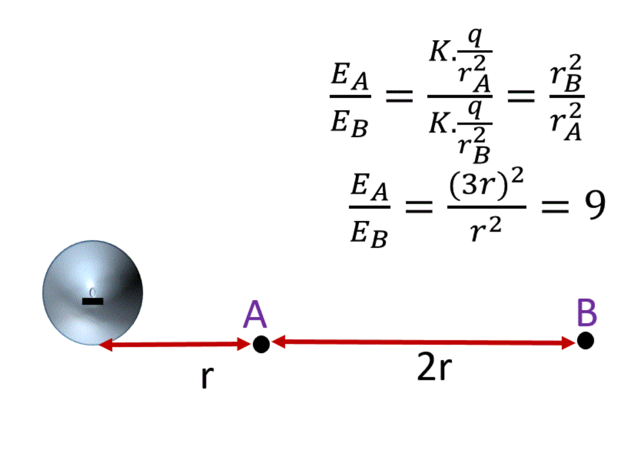
In the figure below, the ratio between the field at point
\[A\] to the field at point \[B\] equals
\[6\;\;\;\;\;\;-C\]
\[ 4 \;\;\;\;\;\;-A\]
\[ 2\;\;\;\;\;\;-D\]
\[9\;\;\;\;\;\;-B\]
Click here to show solution method
Choose the correct answer
\[7 \star\]
One of the following answers is a characteristic of electric field lines

Their density increases as-C
we move away from the charge
Field lines do not intersect-A
They emerge from the negative charge and -D
enter the positive charge
The number of field lines increases as the -B
magnitude of the charge generating the field decreases
Click here to show solution method
Choose the correct answer
\[8 \star \star\]
One of the following answers is not a property of electric field lines

The number of field lines increases as -C
the charge generating the field decreases
They emerge from positive charge and -A
enter negative charge
Field lines do not intersect-D
The density of field lines increases as-B
we get closer to the charge
Click here to show solution
Choose the correct answer
\[9\star \star\]
The electric potential energy of a negative charge increases when it moves

In the direction of the field -C
Perpendicular to the field -A
Opposite to the electric force direction -D
Opposite to the field -B
Click here to show the solution
Choose the correct answer
\[10\star \star\]
The electric potential energy of a positive charge increases when it moves

In the direction of the field -C
In the direction of the electric force -A
Opposite to the electric force direction -D
Opposite to the field -B
Click here to show the solution
Choose the correct answer
\[11 \star\]
One of the following shapes represents a uniform field

Click here to show the solution
Choose the correct answer
\[12\star \star\]
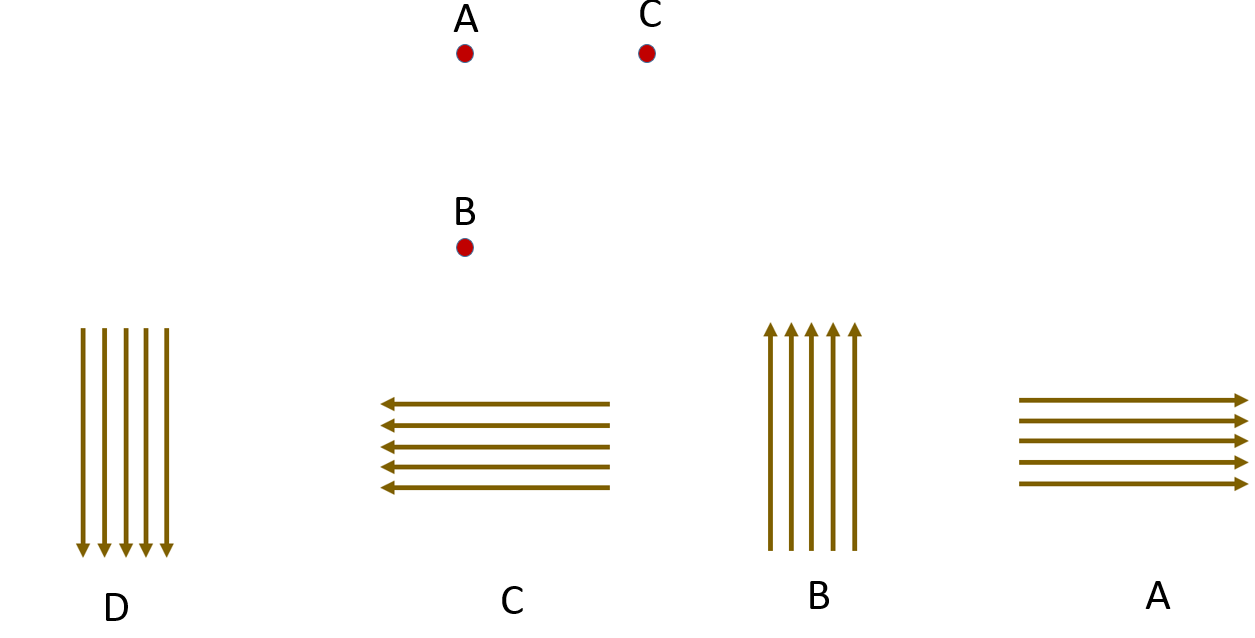
Three points inside a uniform field as shown in the figure below. One of the lines represents the correct shape of the uniform field lines, knowing that \[ V_A=8V , V_B=6V , V_C=8V \]
Click here to show the solution
Choose the correct answer
\[13\star \star\]
The value of electric potential at a point increases when
Moving in a circular path around -C
the field
Moving in the direction of the field -A
Moving opposite to the field direction -D
Moving perpendicular to the field lines -B
Click here to show the solution
Choose the correct answer
\[14 \star\]
In the adjacent figure, there is a uniform electric field.
One of the following answers is correct.

\[ V_a = V_c > V_d \;\;\;\;\;\;-C\]
\[ V_d = V_c > V_a \;\;\;\;\;\;-A\]
\[ V_c = V_d > V_a \;\;\;\;\;\;-D\]
\[ V_a > V_c = V_d \;\;\;\;\;\;-B\]
Click here to show the solution method Choose the correct answer
\[15\star \star\]
In the figure below, there is a uniform electric field with intensity
\[E=1000\frac{N}{C}\]. The potential difference between points \[∆V_{a d}\] equals:

\[ ∆V= 400\; V \;\;\;\;\;\;-C\]
\[ ∆V= 200\; V \;\;\;\;\;\;-A\]
\[ ∆V= 600\; V \;\;\;\;\;\;-D\]
\[ ∆V= 300\; V \;\;\;\;\;\;-B\]
Click here to show the solution method Choose the correct answer
\[16 \star\]
In the figure below, there is a uniform electric field with intensity
\[E=1000\frac{N}{C}\]. The potential difference between points \[∆V_{c d}\] equals:
\[ ∆V= 100\; V \;\;\;\;\;\;-C\]
\[ ∆V= 200\; V \;\;\;\;\;\;-A\]
\[ ∆V= 300\; V \;\;\;\;\;\;-D\]
\[ ∆V= 0.0\; V \;\;\;\;\;\;-B\]
Click here to show the solution method Choose the correct answer
\[17\star \star\]
In Millikan's experiment, an oil drop with mass \[m=2×10^{-8}\; kg\]
was placed between two plates as shown in the figure. The drop became balanced. If the field intensity
equals
\[E=1 ×10^3\frac{N}{C}\]
then the charge of the drop equals

\[ q=1.96×10^{-10} \; C\;\;\;\;\;\;-C\]
\[ q=2.54×10^{-12} \; C \;\;\;\;\;\;-A\]
\[ q=3.42×10^{-13} \; C\;\;\;\;\;\;-D\]
\[ q=9.55×10^{-9} \; C\;\;\;\;\;\;-B\]
Click here to show the solution method Choose the correct answer
\[18\star \star\]
In Millikan's experiment, a charged oil drop
was placed between two plates as shown in the figure. The drop became balanced.
Then the drop

Positive type with electric force upward-C
Negative type and affected-A
by electric force upward
Positive type and affected by electric-D
by electric force downward
Negative type and affected by -B
electric force downward
Click here to show the solution method Choose the correct answer
\[19\star \star\]
A uniform field with electric field intensity between two plates
\[5×10^3\;N/C\] The distance between the plates equals
\[0.06\;m\] Then the potential difference between the plates
equals

\[ ∆V= 600\; V \;\;\;\;\;\;-C\]
\[ ∆V= 200\; V \;\;\;\;\;\;-A\]
\[ ∆V= 60\; V \;\;\;\;\;\;-D\]
\[ ∆V= 300\; V \;\;\;\;\;\;-B\]
Click here to show the solution method Choose the correct answer
\[20\star \star\]
A hollow spherical conductor with radius \[R=0.08\]
was charged with a negative charge of \[Q=3\;𝜇𝑐\]
Then the electric field intensity at a point distant from the conductor's center \[r=0.05\;m\]
equals

\[ E=2.7×10^6\; N/C \;\;\;\;\;\;-C\]
\[ E=5.6×10^6\; N/C \;\;\;\;\;\;-A\]
\[ E=0.0\; N/C \;\;\;\;\;\;-D\]
\[ E=14.4×10^6\; N/C \;\;\;\;\;\;-B\]
Click here to show the solution method Choose the correct answer
\[21 \star\]
A non-uniform field
as shown in the figure
A negatively charged particle
was placed in different positions. The maximum magnitude
of the force experienced
by the negatively charged particle
is at position

Click here to show the solution method Choose the correct answer
\[22 \star\]
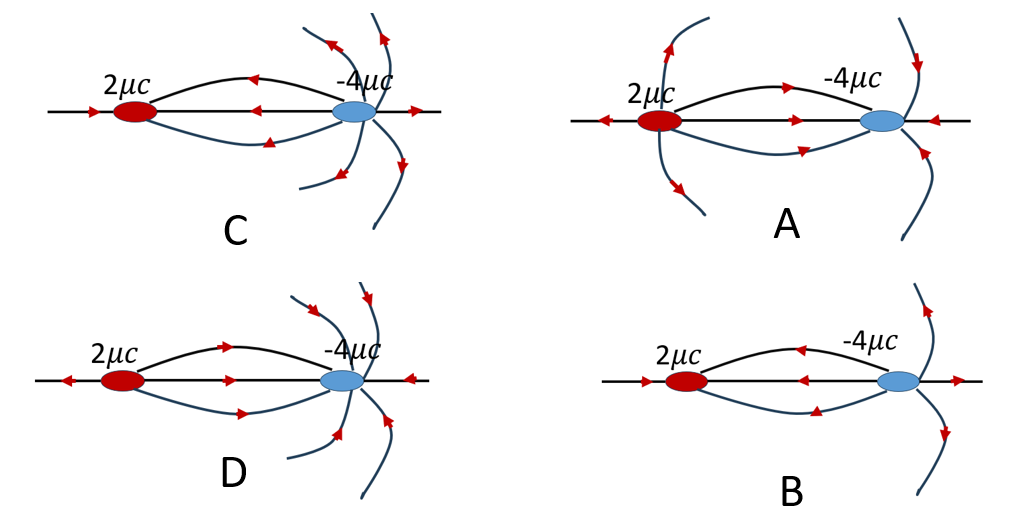
The field lines for two point charges were drawn, each with magnitude
\[Q_1=-4\;𝜇𝑐\;\;\;\;\;\;Q_2=+2\;𝜇𝑐\]
One of the following drawings correctly represents
the field
considering charge density
and type
Click here to show the solution method Choose the correct answer
\[23 \star\]
External work was done on a positive charge and it was moved against the field between two points. One of the following answers
correctly expresses what happened
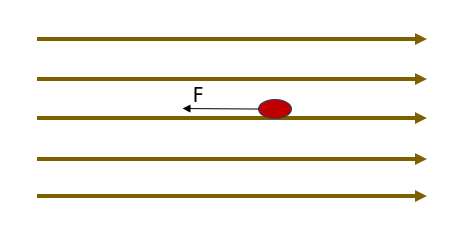
The potential energy of the charge increases -C
and the electric potential difference between the two points decreases
The potential energy of the charge decreases -A
and the electric potential difference between the two points decreases
The potential energy of the charge decreases -D
and the electric potential difference between the two points increases
The potential energy of the charge increases -B
and the electric potential difference between the two points increases
Click here to show the solution method Choose the correct answer
\[24 \star\]
An irregularly shaped conductor was charged
as shown in the figure below
The maximum electric field intensity
at point

Click here to show the solution method Choose the correct answer
Solve the following problems
1

In the figure below, two charges are on the same line \[q_1=+9\;nc\;\;\;\;\;\;\;\;q_2=?\] At point \[A\]
the electric field is zero. Then the magnitude and type of charge
\[q_2\] equals

\[...................................\;\;\;\;\;\;\;...................................\]
\[...................................\;\;\;\;\;\;\;...................................\]\[...................................\;\;\;\;\;\;\;...................................\]
\[...................................\;\;\;\;\;\;\;...................................\]\[...................................\;\;\;\;\;\;\;...................................\]
Click here to show the solution method
2
In the figure below, the field at point \[A\] was calculated
\[E_{net}=1000\frac{N}{C}\]
and its direction is shown in the drawing. If the magnitude of the electric field
resulting from the first charge equals
\[E_{1}=600\frac{N}{C}\] Calculate the type
and magnitude of the second charge

\[...................................\;\;\;\;\;\;\;...................................\]
\[...................................\;\;\;\;\;\;\;...................................\]\[...................................\;\;\;\;\;\;\;...................................\]
\[...................................\;\;\;\;\;\;\;...................................\]\[...................................\;\;\;\;\;\;\;...................................\]
Click here to show the solution method
3
An oil drop with mass and charge \[m=0.003 \;kg\;\;\;\;\;\;\;q=6\;nc\] was released in
a uniform field
The distance between the plates equals
\[0.04\;m\] It was observed that the oil drop is balanced
Calculate the potential difference between the plates

\[...................................\;\;\;\;\;\;\;...................................\]
\[...................................\;\;\;\;\;\;\;...................................\]\[...................................\;\;\;\;\;\;\;...................................\]
\[...................................\;\;\;\;\;\;\;...................................\]\[...................................\;\;\;\;\;\;\;...................................\]
Click here to show the solution method
An electric field with intensity
\[3×10^2\;\;N/C\]
An electron is placed inside the field.
The electric force acting on the electron equals
\[q_e=1.6 ×10^{-19}C\]
\[ Fe= 5.2×10^{-12}\;\; N\;\;\;\;\;\;-C\] In the direction of the field |
\[ Fe= 4.8×10^{-17} \;\; N \;\;\;\;\;\;-A\] In the direction of the field |
\[ Fe= 5.2×10^{-12}\;\; N\;\;\;\;\;\;-D\] Opposite to the field direction |
\[ Fe= 4.8×10^{-17} \;\; N\;\;\;\;\;\;-B\] Opposite to the field direction |
 Click here to show solution
Choose the correct answer
An electric charge of magnitude \[q=+6\;\;µc\]
The electric field at the point
at a distance from the charge equals \[a=0.2 \;\;m\]
\[ E = 6.75×10^{6}\;\; N/C\;\;\;\;\;\;-C\] To the right |
\[ E = 1.35×10^{6} \;\; N/C \;\;\;\;\;\;-A\] To the right |
\[ E = 3.25×10^{6}\;\; N/C\;\;\;\;\;\;-D\] To the left |
\[ E = 4.52×10^{6} \;\; N/C\;\;\;\;\;\;-B\] To the left |
 Click here to show solution
Choose the correct answer
An electric field with intensity \[ E=300 \;\;N/C\]
A particle is placed inside the field and is affected by an electric force of magnitude
\[9×10^{-12}\;\;N\]
in the direction of the field. The type and magnitude of the particle's charge equal
\[ q= 6×10^{-14}\;\;C\;\;\;\;\;\;-C\] Negative |
\[ q= 9×10^{-14} \;\; C \;\;\;\;\;\;-A\] Negative |
\[ q= 4×10^{-14}\;\; C\;\;\;\;\;\;-D\] Positive |
\[ q= 3×10^{-14} \;\; C\;\;\;\;\;\;-B\] Positive |
 Click here to show solution
Choose the correct answer
An electric charge of magnitude
\[Q=4\;\; µc\]
The electric field at point \[A\]
was calculated to be
\[3×10^4\;\;N/C\] The distance of the point from the charge equals
\[r=1.1 \;\;m\;\;\;\;\;\;-C\] |
\[ r=1.4 \;\;m \;\;\;\;\;\;-A\] |
\[ r=0.85 \;\;m\;\;\;\;\;\;-D\] |
\[ r= 0.56 \;\;m\;\;\;\;\;\;-B\] |
Click here to show the solution
Choose the correct answer
One of the following measurement units is equivalent to the unit of electric field measurement
\[Kg.m.A^{-1}S{-1}\;\;\;\;\;\;-C\] |
\[ Kg.m.A^{-2}S{-2} \;\;\;\;\;\;-A\] |
\[ Kg.m.A^{-1}S{-2}\;\;\;\;\;\;-D\] |
\[ Kg.m.A^{-1}S{-3}\;\;\;\;\;\;-B\] |
Click here to show solution method
Choose the correct answer
In the figure below, the ratio between the field at point \[A\] to the field at point \[B\] equals
\[6\;\;\;\;\;\;-C\] |
\[ 4 \;\;\;\;\;\;-A\] |
\[ 2\;\;\;\;\;\;-D\] |
\[9\;\;\;\;\;\;-B\] |
 Click here to show solution method
Choose the correct answer
One of the following answers is a characteristic of electric field lines
Their density increases as-C
|
Field lines do not intersect-A |
They emerge from the negative charge and -D
|
The number of field lines increases as the -B
|
 Click here to show solution method
Choose the correct answer
One of the following answers is not a property of electric field lines
The number of field lines increases as -C
|
They emerge from positive charge and -A
|
Field lines do not intersect-D |
The density of field lines increases as-B
|
 Click here to show solution
Choose the correct answer
The electric potential energy of a negative charge increases when it moves
In the direction of the field -C |
Perpendicular to the field -A |
Opposite to the electric force direction -D |
Opposite to the field -B |
 Click here to show the solution
Choose the correct answer
The electric potential energy of a positive charge increases when it moves
In the direction of the field -C |
In the direction of the electric force -A |
Opposite to the electric force direction -D |
Opposite to the field -B |
Click here to show the solution
Choose the correct answer
One of the following shapes represents a uniform field
 Click here to show the solution
Choose the correct answer
Three points inside a uniform field as shown in the figure below. One of the lines represents the correct shape of the uniform field lines, knowing that \[ V_A=8V , V_B=6V , V_C=8V \]
 Click here to show the solution
Choose the correct answer
The value of electric potential at a point increases when
Moving in a circular path around -C
|
Moving in the direction of the field -A |
Moving opposite to the field direction -D |
Moving perpendicular to the field lines -B |
 Click here to show the solution
Choose the correct answer
In the adjacent figure, there is a uniform electric field. One of the following answers is correct.
\[ V_a = V_c > V_d \;\;\;\;\;\;-C\] |
\[ V_d = V_c > V_a \;\;\;\;\;\;-A\] |
\[ V_c = V_d > V_a \;\;\;\;\;\;-D\] |
\[ V_a > V_c = V_d \;\;\;\;\;\;-B\] |
 Click here to show the solution method
Choose the correct answer
In the figure below, there is a uniform electric field with intensity \[E=1000\frac{N}{C}\]. The potential difference between points \[∆V_{a d}\] equals:
\[ ∆V= 400\; V \;\;\;\;\;\;-C\] |
\[ ∆V= 200\; V \;\;\;\;\;\;-A\] |
\[ ∆V= 600\; V \;\;\;\;\;\;-D\] |
\[ ∆V= 300\; V \;\;\;\;\;\;-B\] |
 Click here to show the solution method
Choose the correct answer
In the figure below, there is a uniform electric field with intensity \[E=1000\frac{N}{C}\]. The potential difference between points \[∆V_{c d}\] equals:
\[ ∆V= 100\; V \;\;\;\;\;\;-C\] |
\[ ∆V= 200\; V \;\;\;\;\;\;-A\] |
\[ ∆V= 300\; V \;\;\;\;\;\;-D\] |
\[ ∆V= 0.0\; V \;\;\;\;\;\;-B\] |
 Click here to show the solution method
Choose the correct answer
In Millikan's experiment, an oil drop with mass \[m=2×10^{-8}\; kg\]
was placed between two plates as shown in the figure. The drop became balanced. If the field intensity
equals
\[E=1 ×10^3\frac{N}{C}\]
then the charge of the drop equals
\[ q=1.96×10^{-10} \; C\;\;\;\;\;\;-C\] |
\[ q=2.54×10^{-12} \; C \;\;\;\;\;\;-A\] |
\[ q=3.42×10^{-13} \; C\;\;\;\;\;\;-D\] |
\[ q=9.55×10^{-9} \; C\;\;\;\;\;\;-B\] |
 Click here to show the solution method
Choose the correct answer
In Millikan's experiment, a charged oil drop
was placed between two plates as shown in the figure. The drop became balanced.
Then the drop
Positive type with electric force upward-C |
Negative type and affected-A |
Positive type and affected by electric-D
|
Negative type and affected by -B
|
 Click here to show the solution method
Choose the correct answer
A uniform field with electric field intensity between two plates
\[5×10^3\;N/C\] The distance between the plates equals
\[0.06\;m\] Then the potential difference between the plates
equals
\[ ∆V= 600\; V \;\;\;\;\;\;-C\] |
\[ ∆V= 200\; V \;\;\;\;\;\;-A\] |
\[ ∆V= 60\; V \;\;\;\;\;\;-D\] |
\[ ∆V= 300\; V \;\;\;\;\;\;-B\] |
 Click here to show the solution method
Choose the correct answer
A hollow spherical conductor with radius \[R=0.08\]
was charged with a negative charge of \[Q=3\;𝜇𝑐\]
Then the electric field intensity at a point distant from the conductor's center \[r=0.05\;m\]
equals
\[ E=2.7×10^6\; N/C \;\;\;\;\;\;-C\] |
\[ E=5.6×10^6\; N/C \;\;\;\;\;\;-A\] |
\[ E=0.0\; N/C \;\;\;\;\;\;-D\] |
\[ E=14.4×10^6\; N/C \;\;\;\;\;\;-B\] |
 Click here to show the solution method
Choose the correct answer
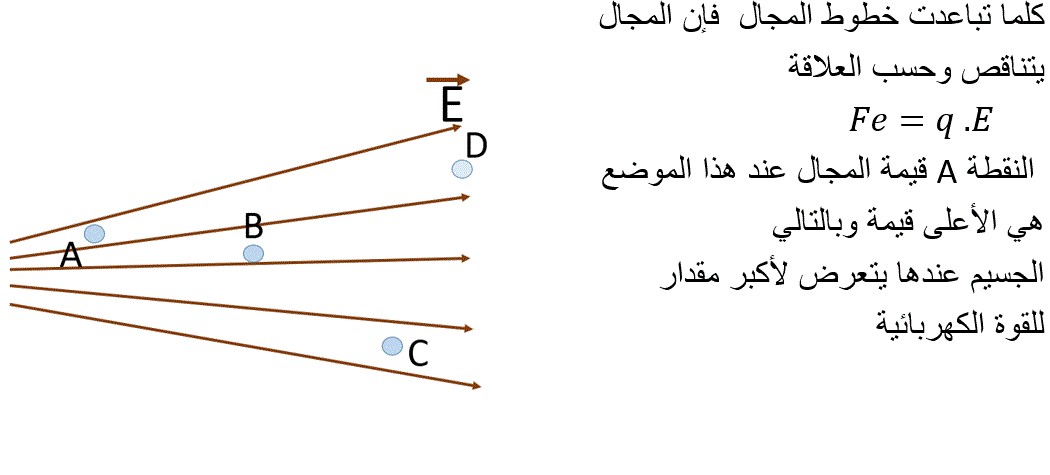
A negatively charged particle was placed in different positions. The maximum magnitude of the force experienced by the negatively charged particle
is at position
 Click here to show the solution method
Choose the correct answer
The field lines for two point charges were drawn, each with magnitude
\[Q_1=-4\;𝜇𝑐\;\;\;\;\;\;Q_2=+2\;𝜇𝑐\]
One of the following drawings correctly represents
the field
considering charge density
and type
Choose the correct answer
 Click here to show the solution method
External work was done on a positive charge and it was moved against the field between two points. One of the following answers
correctly expresses what happened
The potential energy of the charge increases -C
|
The potential energy of the charge decreases -A
|
The potential energy of the charge decreases -D
|
The potential energy of the charge increases -B
|
 Click here to show the solution method
Choose the correct answer
An irregularly shaped conductor was charged
as shown in the figure below
The maximum electric field intensity
at point
 Click here to show the solution method
Choose the correct answer
Solve the following problems
In the figure below, two charges are on the same line \[q_1=+9\;nc\;\;\;\;\;\;\;\;q_2=?\] At point \[A\]
the electric field is zero. Then the magnitude and type of charge
\[q_2\] equals
 Click here to show the solution method
In the figure below, the field at point \[A\] was calculated
\[E_{net}=1000\frac{N}{C}\]
and its direction is shown in the drawing. If the magnitude of the electric field
resulting from the first charge equals
\[E_{1}=600\frac{N}{C}\] Calculate the type
and magnitude of the second charge
 Click here to show the solution method
An oil drop with mass and charge \[m=0.003 \;kg\;\;\;\;\;\;\;q=6\;nc\] was released in a uniform field The distance between the plates equals \[0.04\;m\] It was observed that the oil drop is balanced Calculate the potential difference between the plates
 Click here to show the solution method