 Physics
📄 Print pdf
00971504825082
Question Bank: Vibrations and Waves

\[1\star\]
An object oscillates around its equilibrium position, forming what is known as simple harmonic motion.
One of the following answers represents the relationship between the restoring force and the displacement

The restoring force is inversely proportional - C
to the displacement and has the same direction
The restoring force is directly proportional - A
to the displacement and has the same direction
The restoring force is inversely proportional - D
to the displacement and opposite in direction
The restoring force is directly proportional - B
to the displacement and opposite in direction
 Click here to show the solution
Choose the correct answer
\[2\star\]
An object moves in simple harmonic motion and during the motion, energy transforms from one form to another
At the equilibrium position, one of the following answers is correct

\[ 𝐾𝐸=𝑃𝑒𝑠≠0 \;\;\;\;\;\;-C\]
\[ 𝐾𝐸=0 \;\;\;\;\; 𝑃𝑒𝑠>0 \;\;\;\;\;\;-A\]
\[ 𝐾𝐸=𝑃𝑒𝑠=0 \;\;\;\;\;\;-D\]
\[ 𝐾𝐸>0 \;\;\;\;\; 𝑃𝑒𝑠=0 \;\;\;\;\;\;-B\]
Click here to show solution
Choose the correct answer
\[3\star\]
A spring with length \[L_1=50\;\; cm\]
is fixed at one end and a mass \[m=0.6 \;\;kg\] is hung from the other end
without exceeding the elastic limit
so the spring length becomes
\[L_2=55\;\;cm\] Then the spring constant equals

\[ k= 76.3\; N/m \;\;\;\;\;\;-C\]
\[ k= 55.8\; N/m \;\;\;\;\;\;-A\]
\[ k= 117.7 \;N/m \;\;\;\;\;\;-D\]
\[ k= 93.6\; N/m \;\;\;\;\;\;-B\]
Click here to show solution
Choose the correct answer
\[4\star\]
In an experiment, different masses were hung from a spring fixed at one end
causing the spring to stretch without exceeding the elastic limit
The relationship between tension force and elongation was plotted resulting in the following graph
The maximum potential energy stored in the spring equals

\[ 𝑃𝑒𝑠=1\; J \;\;\;\;\;\;-C\]
\[ 𝑃𝑒𝑠=0.75\;J \;\;\;\;\;\;-A\]
\[ 𝑃𝑒𝑠=0.16 \;J \;\;\;\;\;\;-D\]
\[ 𝑃𝑒𝑠=0.52 \; J \;\;\;\;\;\;-B\]
Click here to show solution
Choose the correct answer
\[5\star\]
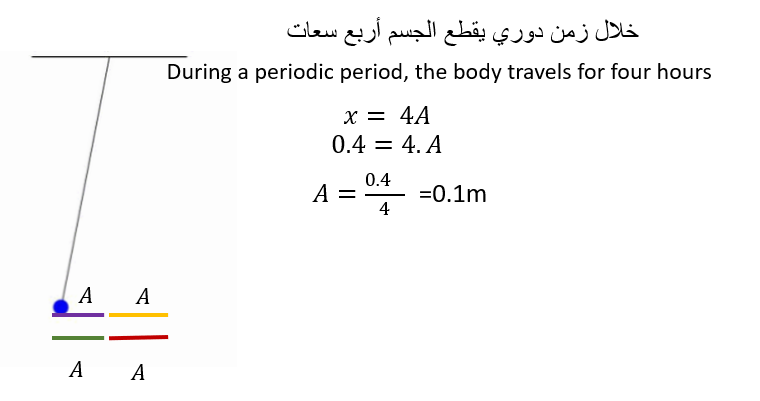
A pendulum moves with simple harmonic motion and covers a distance of \[x=0.4\;\;m\] during one periodic time. The amplitude of the oscillatory motion equals:

\[ A=0.3 \;m \;\;\;\;\;\;-C\]
\[ A=0.1\; m \;\;\;\;\;\;-A\]
\[ A=0.4\; m \;\;\;\;\;\;-D\]
\[ A=0.2\; m \;\;\;\;\;\;-B\]
Click here to show the solution Choose the correct answer
\[6\star\]
Waves are divided into three types: transverse waves, longitudinal waves, and surface waves
One of the following waves is a longitudinal wave

Sound waves -C
Light waves -A
Sea waves -D
Rope waves -B
Click here to show the solution
Choose the correct answer
\[7\star\]
A pendulum of length \[L=2 \;\; m\] is suspended from the ceiling of a spacecraft and in a place in space
It was left to move in simple harmonic motion
To measure the gravitational acceleration, the periodic time was measured and it was equal to
\[T=3.6 \;\;S\] Then the gravitational acceleration in that region is
\[ g=5.3 \;\;m/s^2 \;\;\;\;\;\;-C\]
\[ g=4.5 \;\;m/s^2 \;\;\;\;\;\;-A\]
\[ g=6.1 \;\;m/s^2 \;\;\;\;\;\;-D\]
\[ g=7.6 \;\;m/s^2 \;\;\;\;\;\;-B\]
Click here to show the solution
Choose the correct answer
\[8\star\]
A pendulum of length
\[L\] had its periodic time measured on Earth's surface
Then the same pendulum was taken to the Moon's surface
where the gravitational acceleration is one-sixth of Earth's gravity
The ratio of the pendulum's periodic time on Earth to
the periodic time on the Moon equals
\[ 6 \;\;\;\;\;\;-C\]
\[0.17 \;\;\;\;\;\;-A\]
\[ 2.4 \;\;\;\;\;\;-D\]
\[ 0.4 \;\;\;\;\;\;-B\]
Click here to show the solution
Choose the correct answer
\[9\star\]
A rope forms a transverse wave as shown in the figure below
One of the following answers represents the distance between two points
which equals the wavelength

\[ DJ=𝝀\;\;\;\;\;\;-C\]
\[AF=𝝀 \;\;\;\;\;\;-A\]
\[ BE=𝝀 \;\;\;\;\;\;-D\]
\[ AC=𝝀 \;\;\;\;\;\;-B\]
Click here to show the solution
Choose the correct answer
\[10\star\]
A student created a wave in a rope and recorded the following values for this wave:
\[ 𝑣=8\;\; \frac {m}{s} \;\;\;\;\; 𝑓=4\;\; 𝐻𝑍\;\;\;\;\;𝝀=2\;\; 𝑚\]
The same experiment was repeated by another student and it was noticed that the wavelength became:
\[𝝀=1.5 \;\; 𝑚\]One of the following answers expresses what happened

\[ 𝑓=5.33 𝐻𝑍 \;\;\;\;\; 𝑣=8 m/s \;\;\;\;\;\;-C\]
\[ 𝑓=4 𝐻𝑍 \;\;\;\;\;\; 𝑣=6 m/s \;\;\;\;\;\;-A\]
\[ 𝑓=3.5 𝐻𝑍 \;\;\;\;\; 𝑣=5.25 m/s \;\;\;\;\;\;-D\]
\[ 𝑓=6 𝐻𝑍 \;\;\;\;\; 𝑣=9 m/s \;\;\;\;\;\;-B\]
Click here to show solution Choose the correct answer
\[11\star\]
A transverse wave was plotted showing the relationship between displacement and distance from the source, resulting in the following graph:

If the wave speed is
\[v=4\;\; m/s\], then the frequency of the source is
\[ 𝑓=20 \;\;𝐻𝑍 \;\;\;\;\;\;-C\]
\[𝑓=40 \;\;𝐻𝑍 \;\;\;\;\;\;-A\]
\[ 𝑓=10 \;\;𝐻𝑍 \;\;\;\;\;\;-D\]
\[ 𝑓=2.5 \;\; 𝐻𝑍 \;\;\;\;\;\;-B\]
Click here to show the solution
Choose the correct answer
\[12\star\]
In the figure below, the relationship between displacement and time for a transverse wave was plotted
As shown in the figure below

The wave velocity was \[v=3 \;\;m/s \]. Based on the information and the figure, the frequency and wavelength equal:
\[ f=0.05 HZ \;\;\;\;\; λ=60 m \;\;\;\;\;\;-C\]
\[ f=10 HZ \;\;\;\;\; λ=0.3 m \;\;\;\;\;\;-A\]
\[ f=0.1 HZ \;\;\;\;\; λ=30 m \;\;\;\;\;\;-D\]
\[ f=0.2 HZ \;\;\;\;\; λ=100 m \;\;\;\;\;\;-B\]
Click here to show the solution
Choose the correct answer
\[13\star\]
A rope with length
\[L=2\;\;m\] created a disturbance and hit a barrier forming standing waves
with different shapes. One of the following wavelengths cannot be a standing wave

\[ 𝝀=2 \;m \;\;\;\;\;\;-C\]
\[ 𝝀=4 \; m \;\;\;\;\;\;-A\]
\[ 𝝀=1.33 \; m \;\;\;\;\;\;-D\]
\[ 𝝀=3 \; m \;\;\;\;\;\;-B\]
Click here to show solution
Choose the correct answer
\[14\star\]
A sonar device on a submarine sends a signal to a stationary object
and the echo returns after time \[t=5 \;\; s\] Calculate the speed of sound in water if the distance
of the object from the submarine is \[X=3625 \;\; m\]

\[ 𝑣=1650\;\; m/s\;\;\;\;\;\;-C\]
\[ 𝑣=1750\;\; m/s \;\;\;\;\;\;-A\]
\[ 𝑣=1450\;\; m/s \;\;\;\;\;\;-D\]
\[ 𝑣=1350\;\; m/s \;\;\;\;\;\;-B\]
Click here to show solution
Choose the correct answer
\[15\star\]
A water tank formed a straight wave that hit a barrier
Reflection occurred. One of the following answers describes the properties of the incident and reflected waves

Click here to show solution
Choose the correct answer
\[16\star\]
A deep water tank formed a straight wave that moved to a shallow medium
Refraction occurred
One of the following answers does not describe the properties
of the incident and refracted waves

\[ f _1>f_2 \;\;\;\;\;\;-C\]
\[ λ_1>λ_2 \;\;\;\;\;\;-A\]
\[ θ_1>θ_2 \;\;\;\;\;\;-D\]
\[ v_1>v_2 \;\;\;\;\;\;-B\]
Click here to show solution
Choose the correct answer
\[17\star\]
A wave created in a rope hits a fixed barrier and reflects back

One of the following shapes represents the wave at a certain moment

Click here to show solution
Choose the correct answer
\[18\star \]
A pendulum moves with simple harmonic motion with a period of \[T\]. If the length of the simple pendulum is increased to four times its original length, its period becomes

Decreases to half - C
Increases to double - A
Increases to four times - D
Decreases to quarter - B
Click here to show solution
Choose the correct answer
Answer the following questions
\[1\star \]
A spring of length \[L_1=50\;\; cm\] is fixed at one end and a mass of \[m=0.6 \;\;kg\] is hung from the other end without exceeding the elastic limit, so the spring length becomes \[L_2=55\;\;cm\]. Consider \[g=9.81\;m/s^2\]
Calculate the spring constant equals to
\[.........................................\;\;\;\;\;\;....................................\]
\[........................................\;\;\;\;\;\;....................................\]
\[.........................................\;\;\;\;\;\;....................................\]
\[........................................\;\;\;\;\;\;....................................\]
Click here to show solution
\[2\star\]
In an experiment, different masses were hung from a spring fixed at one end, causing the spring to stretch without exceeding the elastic limit. The relationship between tension force and elongation was plotted, resulting in the following graph:

Calculate the maximum elastic potential energy of the spring using the graph
\[........................................................................................\]
\[........................................................................................\]
\[........................................................................................\]
\[........................................................................................\]
\[........................................................................................\]
Click here to show solution

The force acting on the body at maximum displacement:
\[........................................................................................\]
\[........................................................................................\]
Calculate the kinetic energy at equilibrium position:
\[........................................................................................\]
\[........................................................................................\]
\[........................................................................................\]
\[........................................................................................\]
Click here to show solution
\[3\star\]
A pendulum of length \[L=2 \;\; m\] is hung from the ceiling of a spacecraft in space and left to move in simple harmonic motion. To determine the gravitational acceleration, the periodic time was measured and found to be \[T=3.6 \;\;S\]
Calculate the gravitational acceleration in that region:
\[..........................................\;\;\;\;\;\;........................................\]
\[..........................................\;\;\;\;\;\;........................................\]
Calculate the frequency of the pendulum:
\[..........................................\;\;\;\;\;\;........................................\]
\[..........................................\;\;\;\;\;\;........................................\]
Click here to show solution
A transverse wave was plotted showing the relationship between displacement and distance from the source, resulting in the following graph. If the wave speed is (4 m/s):

Determine the wave amplitude:
\[........................................................................................\]
Calculate the wave frequency:
\[........................................................................................\]
\[........................................................................................\]
\[........................................................................................\]
Click here to show solution
🧮 Calculator
🗑️
✏️ قلم
Question Bank: Vibrations and Waves |
An object oscillates around its equilibrium position, forming what is known as simple harmonic motion.
One of the following answers represents the relationship between the restoring force and the displacement
The restoring force is inversely proportional - C
|
The restoring force is directly proportional - A
|
The restoring force is inversely proportional - D
|
The restoring force is directly proportional - B
|
 Click here to show the solution
Choose the correct answer
An object moves in simple harmonic motion and during the motion, energy transforms from one form to another
At the equilibrium position, one of the following answers is correct
\[ 𝐾𝐸=𝑃𝑒𝑠≠0 \;\;\;\;\;\;-C\] |
\[ 𝐾𝐸=0 \;\;\;\;\; 𝑃𝑒𝑠>0 \;\;\;\;\;\;-A\] |
\[ 𝐾𝐸=𝑃𝑒𝑠=0 \;\;\;\;\;\;-D\] |
\[ 𝐾𝐸>0 \;\;\;\;\; 𝑃𝑒𝑠=0 \;\;\;\;\;\;-B\] |
 Click here to show solution
Choose the correct answer
A spring with length \[L_1=50\;\; cm\]
is fixed at one end and a mass \[m=0.6 \;\;kg\] is hung from the other end
without exceeding the elastic limit
so the spring length becomes
\[L_2=55\;\;cm\] Then the spring constant equals
\[ k= 76.3\; N/m \;\;\;\;\;\;-C\] |
\[ k= 55.8\; N/m \;\;\;\;\;\;-A\] |
\[ k= 117.7 \;N/m \;\;\;\;\;\;-D\] |
\[ k= 93.6\; N/m \;\;\;\;\;\;-B\] |
 Click here to show solution
Choose the correct answer
In an experiment, different masses were hung from a spring fixed at one end
causing the spring to stretch without exceeding the elastic limit
The relationship between tension force and elongation was plotted resulting in the following graph
The maximum potential energy stored in the spring equals
\[ 𝑃𝑒𝑠=1\; J \;\;\;\;\;\;-C\] |
\[ 𝑃𝑒𝑠=0.75\;J \;\;\;\;\;\;-A\] |
\[ 𝑃𝑒𝑠=0.16 \;J \;\;\;\;\;\;-D\] |
\[ 𝑃𝑒𝑠=0.52 \; J \;\;\;\;\;\;-B\] |
 Click here to show solution
Choose the correct answer
A pendulum moves with simple harmonic motion and covers a distance of \[x=0.4\;\;m\] during one periodic time. The amplitude of the oscillatory motion equals:
\[ A=0.3 \;m \;\;\;\;\;\;-C\] |
\[ A=0.1\; m \;\;\;\;\;\;-A\] |
\[ A=0.4\; m \;\;\;\;\;\;-D\] |
\[ A=0.2\; m \;\;\;\;\;\;-B\] |
 Click here to show the solution
Choose the correct answer
Waves are divided into three types: transverse waves, longitudinal waves, and surface waves
One of the following waves is a longitudinal wave
Sound waves -C |
Light waves -A |
Sea waves -D |
Rope waves -B |
 Click here to show the solution
Choose the correct answer
A pendulum of length \[L=2 \;\; m\] is suspended from the ceiling of a spacecraft and in a place in space
It was left to move in simple harmonic motion
To measure the gravitational acceleration, the periodic time was measured and it was equal to
\[T=3.6 \;\;S\] Then the gravitational acceleration in that region is
\[ g=5.3 \;\;m/s^2 \;\;\;\;\;\;-C\] |
\[ g=4.5 \;\;m/s^2 \;\;\;\;\;\;-A\] |
\[ g=6.1 \;\;m/s^2 \;\;\;\;\;\;-D\] |
\[ g=7.6 \;\;m/s^2 \;\;\;\;\;\;-B\] |
 Click here to show the solution
Choose the correct answer
A pendulum of length
\[L\] had its periodic time measured on Earth's surface
Then the same pendulum was taken to the Moon's surface
where the gravitational acceleration is one-sixth of Earth's gravity
The ratio of the pendulum's periodic time on Earth to
the periodic time on the Moon equals
\[ 6 \;\;\;\;\;\;-C\] |
\[0.17 \;\;\;\;\;\;-A\] |
\[ 2.4 \;\;\;\;\;\;-D\] |
\[ 0.4 \;\;\;\;\;\;-B\] |
 Click here to show the solution
Choose the correct answer
A rope forms a transverse wave as shown in the figure below
One of the following answers represents the distance between two points
which equals the wavelength
\[ DJ=𝝀\;\;\;\;\;\;-C\] |
\[AF=𝝀 \;\;\;\;\;\;-A\] |
\[ BE=𝝀 \;\;\;\;\;\;-D\] |
\[ AC=𝝀 \;\;\;\;\;\;-B\] |
 Click here to show the solution
Choose the correct answer
A student created a wave in a rope and recorded the following values for this wave: \[ 𝑣=8\;\; \frac {m}{s} \;\;\;\;\; 𝑓=4\;\; 𝐻𝑍\;\;\;\;\;𝝀=2\;\; 𝑚\] The same experiment was repeated by another student and it was noticed that the wavelength became: \[𝝀=1.5 \;\; 𝑚\]One of the following answers expresses what happened
\[ 𝑓=5.33 𝐻𝑍 \;\;\;\;\; 𝑣=8 m/s \;\;\;\;\;\;-C\] |
\[ 𝑓=4 𝐻𝑍 \;\;\;\;\;\; 𝑣=6 m/s \;\;\;\;\;\;-A\] |
\[ 𝑓=3.5 𝐻𝑍 \;\;\;\;\; 𝑣=5.25 m/s \;\;\;\;\;\;-D\] |
\[ 𝑓=6 𝐻𝑍 \;\;\;\;\; 𝑣=9 m/s \;\;\;\;\;\;-B\] |
 Click here to show solution
Choose the correct answer
A transverse wave was plotted showing the relationship between displacement and distance from the source, resulting in the following graph:
If the wave speed is \[v=4\;\; m/s\], then the frequency of the source is
\[ 𝑓=20 \;\;𝐻𝑍 \;\;\;\;\;\;-C\] |
\[𝑓=40 \;\;𝐻𝑍 \;\;\;\;\;\;-A\] |
\[ 𝑓=10 \;\;𝐻𝑍 \;\;\;\;\;\;-D\] |
\[ 𝑓=2.5 \;\; 𝐻𝑍 \;\;\;\;\;\;-B\] |
 Click here to show the solution
Choose the correct answer
In the figure below, the relationship between displacement and time for a transverse wave was plotted
As shown in the figure below
The wave velocity was \[v=3 \;\;m/s \]. Based on the information and the figure, the frequency and wavelength equal:
\[ f=0.05 HZ \;\;\;\;\; λ=60 m \;\;\;\;\;\;-C\] |
\[ f=10 HZ \;\;\;\;\; λ=0.3 m \;\;\;\;\;\;-A\] |
\[ f=0.1 HZ \;\;\;\;\; λ=30 m \;\;\;\;\;\;-D\] |
\[ f=0.2 HZ \;\;\;\;\; λ=100 m \;\;\;\;\;\;-B\] |
 Click here to show the solution
Choose the correct answer
A rope with length
\[L=2\;\;m\] created a disturbance and hit a barrier forming standing waves
with different shapes. One of the following wavelengths cannot be a standing wave
\[ 𝝀=2 \;m \;\;\;\;\;\;-C\] |
\[ 𝝀=4 \; m \;\;\;\;\;\;-A\] |
\[ 𝝀=1.33 \; m \;\;\;\;\;\;-D\] |
\[ 𝝀=3 \; m \;\;\;\;\;\;-B\] |
 Click here to show solution
Choose the correct answer
A sonar device on a submarine sends a signal to a stationary object and the echo returns after time \[t=5 \;\; s\] Calculate the speed of sound in water if the distance of the object from the submarine is \[X=3625 \;\; m\]
\[ 𝑣=1650\;\; m/s\;\;\;\;\;\;-C\] |
\[ 𝑣=1750\;\; m/s \;\;\;\;\;\;-A\] |
\[ 𝑣=1450\;\; m/s \;\;\;\;\;\;-D\] |
\[ 𝑣=1350\;\; m/s \;\;\;\;\;\;-B\] |
 Click here to show solution
Choose the correct answer
A water tank formed a straight wave that hit a barrier
Reflection occurred. One of the following answers describes the properties of the incident and reflected waves
 Click here to show solution
Choose the correct answer
A deep water tank formed a straight wave that moved to a shallow medium
Refraction occurred
One of the following answers does not describe the properties
of the incident and refracted waves
\[ f _1>f_2 \;\;\;\;\;\;-C\] |
\[ λ_1>λ_2 \;\;\;\;\;\;-A\] |
\[ θ_1>θ_2 \;\;\;\;\;\;-D\] |
\[ v_1>v_2 \;\;\;\;\;\;-B\] |
 Click here to show solution
Choose the correct answer
A wave created in a rope hits a fixed barrier and reflects back
One of the following shapes represents the wave at a certain moment
 Click here to show solution
Choose the correct answer
A pendulum moves with simple harmonic motion with a period of \[T\]. If the length of the simple pendulum is increased to four times its original length, its period becomes
Decreases to half - C |
Increases to double - A |
Increases to four times - D |
Decreases to quarter - B |
 Click here to show solution
Choose the correct answer
Answer the following questions
A spring of length \[L_1=50\;\; cm\] is fixed at one end and a mass of \[m=0.6 \;\;kg\] is hung from the other end without exceeding the elastic limit, so the spring length becomes \[L_2=55\;\;cm\]. Consider \[g=9.81\;m/s^2\]
In an experiment, different masses were hung from a spring fixed at one end, causing the spring to stretch without exceeding the elastic limit. The relationship between tension force and elongation was plotted, resulting in the following graph:
A pendulum of length \[L=2 \;\; m\] is hung from the ceiling of a spacecraft in space and left to move in simple harmonic motion. To determine the gravitational acceleration, the periodic time was measured and found to be \[T=3.6 \;\;S\]
Calculate the gravitational acceleration in that region:
\[..........................................\;\;\;\;\;\;........................................\]
\[..........................................\;\;\;\;\;\;........................................\]
Calculate the frequency of the pendulum:
\[..........................................\;\;\;\;\;\;........................................\]
\[..........................................\;\;\;\;\;\;........................................\]
A transverse wave was plotted showing the relationship between displacement and distance from the source, resulting in the following graph. If the wave speed is (4 m/s):
Calculate the spring constant equals to
\[.........................................\;\;\;\;\;\;....................................\]
\[........................................\;\;\;\;\;\;....................................\]
\[.........................................\;\;\;\;\;\;....................................\]
\[........................................\;\;\;\;\;\;....................................\]
Click here to show solution
Calculate the maximum elastic potential energy of the spring using the graph
\[........................................................................................\]
\[........................................................................................\]
\[........................................................................................\]
\[........................................................................................\]
\[........................................................................................\]
 Click here to show solution
The force acting on the body at maximum displacement:
\[........................................................................................\]
\[........................................................................................\]
Calculate the kinetic energy at equilibrium position:
\[........................................................................................\]
\[........................................................................................\]
\[........................................................................................\]
\[........................................................................................\]
 Click here to show solution
 Click here to show solution
Determine the wave amplitude:
\[........................................................................................\]
Calculate the wave frequency:
\[........................................................................................\]
\[........................................................................................\]
\[........................................................................................\]
 Click here to show solution
No comments:
Post a Comment