 Physics
Fundamentals of Light

What is Light?
Light is a form of energy that can be seen by the human eye. Light travels in a vacuum at a constant speed of
approximately 300,000 kilometers per second, which is the fastest known speed in the universe.
Light Travels in Straight Lines
Light travels in straight lines due to its wave nature. This property allows us to form shadows and understand how
cameras and the human eye work.
Evidence: When we shine light on a metal plate, a shadow appears behind the barrier. If light did not travel in
straight lines, light would appear behind the metal plate.
Objects are classified as luminous and non-luminous (illuminated). What does that mean?
There are luminous objects that emit their own light, such as the sun, fire, fireflies, and a lamp.
And there are non-luminous (illuminated) objects that reflect light from luminous objects, such as the moon, a
book, and trees.

Objects are classified based on their ability to transmit light into three types. What are they?
There are transparent objects that allow all light to pass through, like glass.
And there are objects that allow some light to pass through, like frosted glass.
And there are objects that do not allow any light to pass through, like a book.


In this simulation, we will use different lamps. Turn on the lamp switch and
observe the number of rays emitted from each lamp.
Change the lamp using the arrow; there are four different lamps.
The number of rays emitted from the source is called the Luminous
Flux and is measured in Lumens (lm). The symbol for luminous flux is P or ∅.
(lm )
The symbol for luminous flux is
P or ∅
Light Flux Simulation Experiment
This experiment allows you to choose a different lamp and observe the number of rays emitted from it. Use the arrows to switch between the four different lamps.
Lighting Settings
Choose Lamp
Incandescent
LED
Halogen
Fluorescent
Information about Incandescent Lamp
An incandescent lamp works by heating a tungsten filament until it glows. It features warm light but has low efficiency in converting energy to light.
Lamp Type
Number of Rays
Light Intensity
Energy Efficiency
Incandescent
20
75%
10%
Power (Energy Consumed)
Luminous Flux (Light Emitted)
Illuminance (On Surface)
60
Watt
600
Lumen
66.7
Lux
Brightness of Light
When we light a candle, we see its light from all directions.
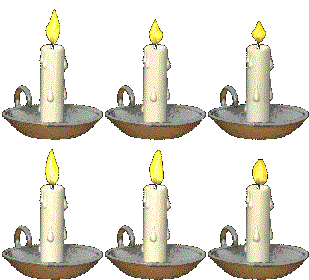

because they are spherical waves that spread in all directions.
The surface area of a sphere is \[4𝜋r^2\]
We call the number of rays emitted per unit area the Illuminance.
\[E\] \[E =\frac{ P} { 4𝜋r^2} \] and it is measured in Lux \[LX\]
Note the relationship between Illuminance, distance from the source, and luminous flux.
As distance
increases, illuminance decreases; the relationship is inversely proportional to the square of the distance.
In this simulation, we will study illuminance and its relationship with distance.
There are locks; the lock
on the left fixes the distance, and the one next to it fixes the angle.
We will not study the effect of the
angle; we will study the relationship between illuminance and distance. Change the distance each time and
determine the illuminance value.
Interactive Experiment: Relationship Between Illuminance and Distance from Light Source
Interactive Experiment: Relationship Between Illuminance and Distance from Light Source
Light Intensity: 100%
Illuminance (lux)
27.78
Distance (meters)
3.0
Luminous Flux (lumens)
1000
Experiment Table
Experiment No.
Luminous Flux (lumens)
Distance from Source (meters)
Squared Distance from Source (m²)
Illuminance (lux)
Theoretical Explanation
Illuminance is the amount of light falling on a surface, measured in lux.
Illuminance is directly proportional to luminous flux and inversely proportional to the square of the distance from the light source.
\[E = \frac {Φ }{ 4πd²}\]
Where:
- E: Illuminance (in lux)
- Φ: Luminous flux (in lumens)
- d: Distance from the light source (in meters)
- π: Pi constant (3.1416)
From this equation, we observe that as the distance from the light source increases, the illuminance decreases significantly (inverse relationship with the square of the distance).
In this experiment, you can change the distance and luminous flux by entering values in the fields.
\[1 \star\]
A light source has a flux of 300 Lumens.
The brightness of the light at a distance
of 0.5 meters is equal to

Choose the
correct answer
A
95.5 LX
B
105.5 LX
C
66.7 LX
D
75.8 LX
 Click here to show the solution method
\[2 \star\]
Click here to show the solution method
\[2 \star\]
In the adjacent figure, the ratio of the brightness seen by
observer \[A\] to the brightness seen by observer \[B\] is equal
to

Choose the correct answer
A
2
B
9
C
6
D
4
Click here to show the solution method
\[3 \star\]
In the adjacent figure, the brightness of
the light seen by observer \[A\] is equal
to four times the brightness seen by
observer \[B\].
Then observer \[A\] is
standing at a distance of

Choose the correct answer
A
0.5 m
B
1 m
C
1.5 m
D
2 m
Light Intensity
Light Intensity
Light intensity is a physical quantity that measures the luminous power emitted from a light source in a specific direction. In other words, it is the amount of luminous flux (light energy) emitted per unit solid angle.
Unit: Measured in candela, symbolized by cd. The candela is one of the basic international units.
[Cd]
Special Case: Symmetrical Source
A symmetrical light source (or ideally diffuse) is a source that emits light with the same intensity in all directions. Practically, there is no ideal source with these specifications, but ordinary incandescent lamps are considered reasonably good approximations of this model.
In this special case, the light intensity [I] is constant and equal in all directions.
To find the total luminous flux [P] emitted from this source, we integrate (sum) the luminous flux across all solid angles in the spherical space surrounding the source.
Derivation of the relationship:
I = P / (4π)
Illustrative Example
Let's assume we have an incandescent lamp (a nearly symmetrical source) that consumes a certain amount of energy and produces a total luminous flux of:
P = 1256 Lm
Required: Calculate the light intensity of this lamp (assuming it is symmetrical).
We apply the relationship:
I = P / (4π)
Substitute the values:
I = 1256 lm / (4 × 3.1416) ≈ 1256 / 12.5664
Result:
I ≈ 100 cd
Quick Quiz: Light and Its Properties

Diffraction of Light
Diffraction: The bending of a wave's direction of propagation when it passes through narrow openings or around the edges of barriers.
Diffraction is a phenomenon specific to waves only.
Light diffracts from its path, so it is a wave.
Light is difficult to diffract because its wavelength is very small. To diffract, the thickness of the barrier or the width of the opening must be close to the wavelength.
Colors
White light consists of seven colors, which are the colors of the spectrum, each with a different wavelength. They are:
Red - Orange - Yellow - Green - Blue - Indigo - Violet
The one with the largest wavelength is red, and the one with the smallest wavelength is violet.
When they enter a prism, each color has a specific speed according to its wavelength, so they disperse into the seven colors of the spectrum.
The primary colors of light are three colors called the primary colors:
Red - Green - Blue
When mixed in equal proportions, they give us white light.
Red + Green = Yellow
Red + Blue = Magenta
Blue + Green = Cyan
In this simulation, we will verify the written results.
Pigments
The primary colors for pigments are three colors called the primary colors:
(Cyan) - Magenta - Yellow
When mixed in equal proportions, they give us black.
Magenta + Yellow = Red
Magenta + Cyan = Blue
Yellow + Cyan = Green
In this simulation, we will verify the written results.
How do we see objects in their colors?
We see objects in their colors due to the way light interacts with these objects:
1. A light source (like the sun or a lamp) emits light containing different colors of the spectrum.
2. When light falls on an object, the object absorbs some colors of the spectrum and reflects others.
3. The color we see is the color that the object reflects to our eyes.
4. For example, a red object absorbs all colors except red, which it reflects, so we see it as red.
5. A black object absorbs all colors and reflects no color, so we see it as black.
6. A white object reflects all colors, so we see it as white.
Interactive Experiment: Seeing Objects in Color Under Different Lights
This experiment explains how we see objects in different colors when colored lights are shone on them.
First select the object color, then select the light color to see how the object will appear.
Experiment Control
Select Object Color:
Select Light Color:
Light Box
Current Object Color: Red
Current Light Color: White
Apparent Color: Red
Resulting Color Appearance:
How Does Color Vision Work?
We see objects as colored because they absorb some colors of the light spectrum and reflect others. When white light falls on a red object, the object absorbs all colors except red, which it reflects to our eyes, so we see it as red.
When we shine colored light on an object, we see the color that the object reflects. If red light falls on a red object, the object will reflect the red light and we will see it as red. But if green light falls on a red object, the object will absorb the green light and not reflect any light, so we will see it as black.
Try it yourself: Select a red object and then shine green or blue light on it to see how it appears black.
Quick Quiz: Color Theory
Polarization
Polarization is a property that describes the direction of vibration of an electromagnetic wave.
Natural light is unpolarized and vibrates in all directions.
Polarized light vibrates in one specific direction only.
Polarization can be achieved by several methods: absorption, reflection, double refraction (birefringence), and scattering.
Polarization can be understood using a rope as a model for light waves. When the vibrations are parallel to the slit, they pass through.

When they are perpendicular to the slit, they do not pass through.

How do we polarize light? (Methods of Polarization)
There are several physical phenomena used to polarize light:
Polarization by Absorption (or using polarizing filters):
This is the most common method in daily applications (like sunglasses).
These filters contain long, chain-like molecules that absorb light vibrating in a specific direction and allow light vibrating in the perpendicular direction to pass through.
Polarization by Reflection:
When light is reflected from a non-metallic surface (like glass, water, or paint), it becomes partially or completely horizontally polarized.
Brewster's angle exists, which is a specific angle of incidence at which the reflected light becomes completely linearly polarized. At this angle, the refracted and reflected rays are perpendicular.
Polarization by Double Refraction (Birefringence):
Some crystals (like calcite or asbestos) have two different refractive indices.
When light enters these crystals, it splits into two rays polarized perpendicularly: the ordinary ray and the extraordinary ray.
Polarization by Scattering:
When light travels through the atmosphere, its waves collide with air molecules and scatter.
Light scattered from the sky (blue color) is partially polarized. The degree of polarization is highest at a 90-degree angle from the sun.
Malus's Law in Polarization
Malus's Law states the relationship between the intensity of light after passing through a second polarizing filter and the angle
\[(θ)\]
between the polarization axes of the two filters.
Let's assume we have an unpolarized light source (like a regular lamp) or light that is already polarized.
The first filter (the polarizer): converts unpolarized light into linearly polarized light. Let the intensity of light after this filter be
\[I₀\].
The second filter (the analyzer): placed after the first filter. The polarization axis of this filter makes an angle
\[(θ)\]
with the polarization axis of the first filter.
The mathematical formula of the law:
\[I = I₀ * cos²(θ)\]
Where:
I: The intensity of the output light after passing through the second filter (the analyzer).
I₀: The intensity of the light incident on the second filter (which is the polarized light coming from the first filter).
θ: The angle between the polarization axes of the two filters.
Interpreting results based on the angle
From the equation \[I = I₀ * cos²(θ),\] we can deduce the following:
When the axes are parallel \[(θ = 0° or θ = 180°)\]
\[cos(0°) = 1, \;\; cos²(0°) = 1.\]
\[I = I₀\]
Result: Maximum light intensity passes through. The polarized light from the first filter passes completely through the second filter.
When the axes are perpendicular \[(θ = 90° or θ = 270°)\]
\[cos(90°) = 0, \;\; cos²(90°) = 0.\]
\[I = 0\]
Result: No light passes through at all (complete darkness). The second filter blocks all vibrations of the light coming from the first filter.
At any other angle
\[ 0°< θ > 90°\]
The resulting light intensity is between zero and maximum
\[0 >I \;\;\;I₀>I \]
For example, when\[ θ = 60°\]
\[cos(60°) = 0.5\]
\[cos²(60°) = 0.25\]
\[I = I₀ * 0.25\]
Meaning only a quarter of the incident light intensity passes through.
Solved Example
Unpolarized light with initial intensity
\[I_0\]
falls on a system of two polarizers. The polarization axis of the first polarizer
is perpendicular to the polarization axis of the second polarizer.
If a third polarizer
is inserted between them, such that its polarization axis makes an angle
\[ θ=30^0\]
with the polarization axis of the first polarizer.
Find the final intensity of the light
exiting the third polarizer
in terms of the initial intensity
, find the final intensity of the light
exiting the second polarizer
in terms of the initial intensity
Solution
When unpolarized light passes through a polarizer, its intensity becomes half of the initial intensity and it becomes polarized in the direction of that polarizer's axis.
\[I_1=\frac {1}{2}I_0\]
Since the axis of
the first polarizer
is perpendicular to the axis of
the second polarizer
therefore, the intensity of the light exiting the
second polarizer is zero
\[I=0.5 I_0 cos²(90°)=0\]
When inserting the third polarizer
we will calculate the light intensity after each polarizer separately
Light exiting the third polarizer
\[I_3=\frac {1}{2}I_0cos²(30°)=\frac {3}{8}I_0\]
Light exiting the second polarizer
\[θ_2=90^0-30^0=60^0\]
\[I_2=I_3cos²(60°)\]
\[I_2=\frac {3}{8}I_0cos²(60°)=\frac {3}{32}I_0\]
Quick Quiz: Polarization
Relative Motion and Light
What happens if a light source moves towards you or you move towards a light source?
If the sound source or the listener is moving, the frequency of the sound heard by the listener will change, and this is true for light as well.
The Doppler effect for light involves only the relative velocity between the source and the observer.
The reason is that light waves are not vibrations of particles in a mechanical medium as is the case with sound.
Also, the difference between the Doppler shift in sound and light:
The speed of light is constant in a given medium, and wind speed does not affect the shift of light.
When a light source moves relative to an observer, the observed frequency of the light changes. If the source is moving towards the observer, the frequency increases (blue shift). If the source is moving away from the observer, the frequency decreases (red shift).
Apparent Frequency
\[ ƒ_{obs} = ƒ ( 1 ± \frac {v }{ C}) \]
We use the plus sign ( + ) if they are moving towards each other.
We use the minus sign ( - ) if they are moving apart.
Apparent Wavelength
\[ λ_{obs} = λ ( 1 ∓ \frac {v }{ C}) \]
\[ ∆λ =( λ_{obs} - λ ) = ∓ λ\frac {v}{C}\]
We use the minus sign ( - ) for the wavelength change if they are moving towards each other (approaching).
We use the plus sign ( + ) for the wavelength change if they are moving apart (receding).
Quick Quiz: Doppler Effect
🧮 Calculator
🗑️
✏️ قلم
Fundamentals of Light |
What is Light?
Light is a form of energy that can be seen by the human eye. Light travels in a vacuum at a constant speed of approximately 300,000 kilometers per second, which is the fastest known speed in the universe.
Light Travels in Straight Lines
Light travels in straight lines due to its wave nature. This property allows us to form shadows and understand how cameras and the human eye work.
Evidence: When we shine light on a metal plate, a shadow appears behind the barrier. If light did not travel in straight lines, light would appear behind the metal plate.
Objects are classified as luminous and non-luminous (illuminated). What does that mean?
There are luminous objects that emit their own light, such as the sun, fire, fireflies, and a lamp.
And there are non-luminous (illuminated) objects that reflect light from luminous objects, such as the moon, a book, and trees.
Objects are classified based on their ability to transmit light into three types. What are they?
There are transparent objects that allow all light to pass through, like glass.
And there are objects that allow some light to pass through, like frosted glass.
And there are objects that do not allow any light to pass through, like a book.
In this simulation, we will use different lamps. Turn on the lamp switch and observe the number of rays emitted from each lamp.
Change the lamp using the arrow; there are four different lamps.
The number of rays emitted from the source is called the Luminous Flux and is measured in Lumens (lm). The symbol for luminous flux is P or ∅.
(lm )
The symbol for luminous flux is
P or ∅
Light Flux Simulation Experiment
This experiment allows you to choose a different lamp and observe the number of rays emitted from it. Use the arrows to switch between the four different lamps.
Lighting Settings
Choose Lamp
Information about Incandescent Lamp
An incandescent lamp works by heating a tungsten filament until it glows. It features warm light but has low efficiency in converting energy to light.
| Lamp Type | Number of Rays | Light Intensity | Energy Efficiency |
|---|---|---|---|
Incandescent |
20 |
75% |
10% |
| Power (Energy Consumed) | Luminous Flux (Light Emitted) | Illuminance (On Surface) |
|---|---|---|
|
60
Watt
|
600
Lumen
|
66.7
Lux
|
Brightness of Light When we light a candle, we see its light from all directions.
because they are spherical waves that spread in all directions.
The surface area of a sphere is \[4𝜋r^2\] We call the number of rays emitted per unit area the Illuminance. \[E\] \[E =\frac{ P} { 4𝜋r^2} \] and it is measured in Lux \[LX\] Note the relationship between Illuminance, distance from the source, and luminous flux.
As distance increases, illuminance decreases; the relationship is inversely proportional to the square of the distance.
In this simulation, we will study illuminance and its relationship with distance.
There are locks; the lock on the left fixes the distance, and the one next to it fixes the angle.
We will not study the effect of the angle; we will study the relationship between illuminance and distance. Change the distance each time and determine the illuminance value.
Interactive Experiment: Relationship Between Illuminance and Distance from Light Source
Illuminance (lux)
Distance (meters)
Luminous Flux (lumens)
Experiment Table
| Experiment No. | Luminous Flux (lumens) | Distance from Source (meters) | Squared Distance from Source (m²) | Illuminance (lux) |
|---|
Theoretical Explanation
Illuminance is the amount of light falling on a surface, measured in lux.
Illuminance is directly proportional to luminous flux and inversely proportional to the square of the distance from the light source.
Where:
- E: Illuminance (in lux)
- Φ: Luminous flux (in lumens)
- d: Distance from the light source (in meters)
- π: Pi constant (3.1416)
From this equation, we observe that as the distance from the light source increases, the illuminance decreases significantly (inverse relationship with the square of the distance).
In this experiment, you can change the distance and luminous flux by entering values in the fields.
A light source has a flux of 300 Lumens.
The brightness of the light at a distance
of 0.5 meters is equal to
Choose the correct answer
Click here to show the solution method
In the adjacent figure, the ratio of the brightness seen by observer \[A\] to the brightness seen by observer \[B\] is equal to
Choose the correct answer
Click here to show the solution method
In the adjacent figure, the brightness of
the light seen by observer \[A\] is equal
to four times the brightness seen by
observer \[B\].
Then observer \[A\] is
standing at a distance of
Choose the correct answer
Light Intensity
Light Intensity
Light intensity is a physical quantity that measures the luminous power emitted from a light source in a specific direction. In other words, it is the amount of luminous flux (light energy) emitted per unit solid angle.
Unit: Measured in candela, symbolized by cd. The candela is one of the basic international units.
[Cd]
Special Case: Symmetrical Source
A symmetrical light source (or ideally diffuse) is a source that emits light with the same intensity in all directions. Practically, there is no ideal source with these specifications, but ordinary incandescent lamps are considered reasonably good approximations of this model.
In this special case, the light intensity [I] is constant and equal in all directions.
To find the total luminous flux [P] emitted from this source, we integrate (sum) the luminous flux across all solid angles in the spherical space surrounding the source.
Derivation of the relationship:
I = P / (4π)
Illustrative Example
Let's assume we have an incandescent lamp (a nearly symmetrical source) that consumes a certain amount of energy and produces a total luminous flux of:
P = 1256 Lm
Required: Calculate the light intensity of this lamp (assuming it is symmetrical).
We apply the relationship:
I = P / (4π)
Substitute the values:
I = 1256 lm / (4 × 3.1416) ≈ 1256 / 12.5664
Result:
I ≈ 100 cd
Quick Quiz: Light and Its Properties
Diffraction of LightDiffraction: The bending of a wave's direction of propagation when it passes through narrow openings or around the edges of barriers.
Diffraction is a phenomenon specific to waves only.
Light diffracts from its path, so it is a wave.
Light is difficult to diffract because its wavelength is very small. To diffract, the thickness of the barrier or the width of the opening must be close to the wavelength.
Colors
White light consists of seven colors, which are the colors of the spectrum, each with a different wavelength. They are:
Red - Orange - Yellow - Green - Blue - Indigo - Violet
The one with the largest wavelength is red, and the one with the smallest wavelength is violet.
When they enter a prism, each color has a specific speed according to its wavelength, so they disperse into the seven colors of the spectrum.
The primary colors of light are three colors called the primary colors:
Red - Green - Blue
When mixed in equal proportions, they give us white light.
Red + Green = Yellow
Red + Blue = Magenta
Blue + Green = Cyan
In this simulation, we will verify the written results.
PigmentsThe primary colors for pigments are three colors called the primary colors:
(Cyan) - Magenta - Yellow
When mixed in equal proportions, they give us black.
Magenta + Yellow = Red
Magenta + Cyan = Blue
Yellow + Cyan = Green
In this simulation, we will verify the written results.
How do we see objects in their colors?
We see objects in their colors due to the way light interacts with these objects:
1. A light source (like the sun or a lamp) emits light containing different colors of the spectrum.
2. When light falls on an object, the object absorbs some colors of the spectrum and reflects others.
3. The color we see is the color that the object reflects to our eyes.
4. For example, a red object absorbs all colors except red, which it reflects, so we see it as red.
5. A black object absorbs all colors and reflects no color, so we see it as black.
6. A white object reflects all colors, so we see it as white.
Interactive Experiment: Seeing Objects in Color Under Different Lights
This experiment explains how we see objects in different colors when colored lights are shone on them. First select the object color, then select the light color to see how the object will appear.
Experiment Control
Select Object Color:
Select Light Color:
Light Box
Current Object Color: Red
Current Light Color: White
Apparent Color: Red
Resulting Color Appearance:
How Does Color Vision Work?
We see objects as colored because they absorb some colors of the light spectrum and reflect others. When white light falls on a red object, the object absorbs all colors except red, which it reflects to our eyes, so we see it as red.
When we shine colored light on an object, we see the color that the object reflects. If red light falls on a red object, the object will reflect the red light and we will see it as red. But if green light falls on a red object, the object will absorb the green light and not reflect any light, so we will see it as black.
Try it yourself: Select a red object and then shine green or blue light on it to see how it appears black.
Quick Quiz: Color Theory
Polarization
Polarization is a property that describes the direction of vibration of an electromagnetic wave.
Natural light is unpolarized and vibrates in all directions.
Polarized light vibrates in one specific direction only.
Polarization can be achieved by several methods: absorption, reflection, double refraction (birefringence), and scattering.
Polarization can be understood using a rope as a model for light waves. When the vibrations are parallel to the slit, they pass through.
When they are perpendicular to the slit, they do not pass through.
How do we polarize light? (Methods of Polarization)
There are several physical phenomena used to polarize light:Polarization by Absorption (or using polarizing filters):
This is the most common method in daily applications (like sunglasses).
These filters contain long, chain-like molecules that absorb light vibrating in a specific direction and allow light vibrating in the perpendicular direction to pass through.
Polarization by Reflection:
When light is reflected from a non-metallic surface (like glass, water, or paint), it becomes partially or completely horizontally polarized.
Brewster's angle exists, which is a specific angle of incidence at which the reflected light becomes completely linearly polarized. At this angle, the refracted and reflected rays are perpendicular.
Polarization by Double Refraction (Birefringence):
Some crystals (like calcite or asbestos) have two different refractive indices.
When light enters these crystals, it splits into two rays polarized perpendicularly: the ordinary ray and the extraordinary ray.
Polarization by Scattering:
When light travels through the atmosphere, its waves collide with air molecules and scatter.
Light scattered from the sky (blue color) is partially polarized. The degree of polarization is highest at a 90-degree angle from the sun.
Malus's Law in Polarization
Malus's Law states the relationship between the intensity of light after passing through a second polarizing filter and the angle \[(θ)\] between the polarization axes of the two filters. Let's assume we have an unpolarized light source (like a regular lamp) or light that is already polarized. The first filter (the polarizer): converts unpolarized light into linearly polarized light. Let the intensity of light after this filter be \[I₀\]. The second filter (the analyzer): placed after the first filter. The polarization axis of this filter makes an angle \[(θ)\] with the polarization axis of the first filter. The mathematical formula of the law: \[I = I₀ * cos²(θ)\] Where:I: The intensity of the output light after passing through the second filter (the analyzer).
I₀: The intensity of the light incident on the second filter (which is the polarized light coming from the first filter).
θ: The angle between the polarization axes of the two filters.
Interpreting results based on the angle From the equation \[I = I₀ * cos²(θ),\] we can deduce the following: When the axes are parallel \[(θ = 0° or θ = 180°)\] \[cos(0°) = 1, \;\; cos²(0°) = 1.\] \[I = I₀\] Result: Maximum light intensity passes through. The polarized light from the first filter passes completely through the second filter.
When the axes are perpendicular \[(θ = 90° or θ = 270°)\] \[cos(90°) = 0, \;\; cos²(90°) = 0.\] \[I = 0\] Result: No light passes through at all (complete darkness). The second filter blocks all vibrations of the light coming from the first filter. At any other angle \[ 0°< θ > 90°\] The resulting light intensity is between zero and maximum \[0 >I \;\;\;I₀>I \] For example, when\[ θ = 60°\] \[cos(60°) = 0.5\] \[cos²(60°) = 0.25\] \[I = I₀ * 0.25\] Meaning only a quarter of the incident light intensity passes through.
Solved Example
Unpolarized light with initial intensity \[I_0\] falls on a system of two polarizers. The polarization axis of the first polarizer is perpendicular to the polarization axis of the second polarizer.If a third polarizer is inserted between them, such that its polarization axis makes an angle \[ θ=30^0\] with the polarization axis of the first polarizer.
Find the final intensity of the light exiting the third polarizer in terms of the initial intensity , find the final intensity of the light exiting the second polarizer in terms of the initial intensity
Solution
When unpolarized light passes through a polarizer, its intensity becomes half of the initial intensity and it becomes polarized in the direction of that polarizer's axis. \[I_1=\frac {1}{2}I_0\] Since the axis of the first polarizer is perpendicular to the axis of the second polarizer therefore, the intensity of the light exiting the second polarizer is zero \[I=0.5 I_0 cos²(90°)=0\] When inserting the third polarizer we will calculate the light intensity after each polarizer separately Light exiting the third polarizer \[I_3=\frac {1}{2}I_0cos²(30°)=\frac {3}{8}I_0\] Light exiting the second polarizer \[θ_2=90^0-30^0=60^0\] \[I_2=I_3cos²(60°)\] \[I_2=\frac {3}{8}I_0cos²(60°)=\frac {3}{32}I_0\]
Quick Quiz: Polarization
Relative Motion and Light
What happens if a light source moves towards you or you move towards a light source?If the sound source or the listener is moving, the frequency of the sound heard by the listener will change, and this is true for light as well.
The Doppler effect for light involves only the relative velocity between the source and the observer. The reason is that light waves are not vibrations of particles in a mechanical medium as is the case with sound.
Also, the difference between the Doppler shift in sound and light: The speed of light is constant in a given medium, and wind speed does not affect the shift of light.
When a light source moves relative to an observer, the observed frequency of the light changes. If the source is moving towards the observer, the frequency increases (blue shift). If the source is moving away from the observer, the frequency decreases (red shift).
Apparent Frequency
\[ ƒ_{obs} = ƒ ( 1 ± \frac {v }{ C}) \] We use the plus sign ( + ) if they are moving towards each other.
We use the minus sign ( - ) if they are moving apart.
Apparent Wavelength
\[ λ_{obs} = λ ( 1 ∓ \frac {v }{ C}) \] \[ ∆λ =( λ_{obs} - λ ) = ∓ λ\frac {v}{C}\] We use the minus sign ( - ) for the wavelength change if they are moving towards each other (approaching).
We use the plus sign ( + ) for the wavelength change if they are moving apart (receding).
Quick Quiz: Doppler Effect
No comments:
Post a Comment